
Osool AI CFO
Responsible usage and AI CFO limits
Practical rules for using AI analysis without treating it as the final decision.
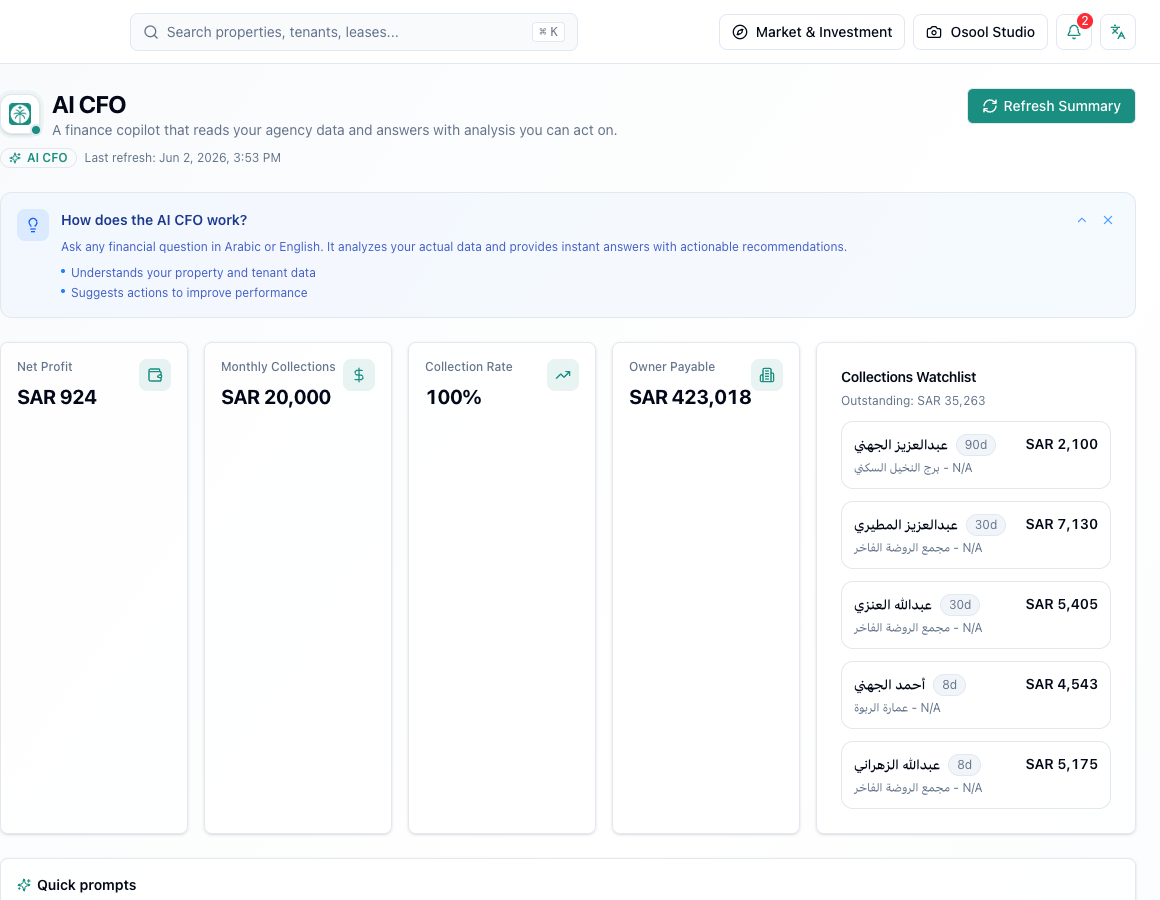
Product Screenshots
What to do
Ask specific questions, verify numbers from source pages, and do not rely on AI alone for sensitive legal, tax, or financial decisions.
Risk and anomaly detection
Risk and anomaly analysis exists in parts of the system, but outputs should be treated as review signals rather than definitive proof.
Data to confirm before asking AI CFO
Every AI CFO answer depends on lease, collection, expense, and owner balance quality. If the source data is incomplete, the answer will be incomplete.
Use AI CFO for analysis, question framing, and suggested actions, then review results with a person before execution.
- Leases
- Collections
- Expenses
- Owner balances
- Cashflow
- Human review
How to apply this inside the agency
Turn the article into a small dashboard action: open the related record, review the data, make the appropriate update, then document the outcome so the rest of the team can see it.
If the action involves a financial, regulatory, owner, or tenant-impacting decision, ask the responsible role to review it before final approval.
- Open the record
- Review data
- Take action
- Document outcome
- Escalate when needed
Product status and review needed
This is documented as an available workflow, but results can still vary by user permissions, agency settings, and data quality.
If a step described here is not visible in the agency dashboard, treat it as not enabled for your account and check with your admin or Product.
Related Articles
Osool AI CFO
Asking financial questions in AI CFO
Examples of questions agencies can ask about collections, risks, balances, and profitability.
Read articleMarket Analysis
Using market analysis and city indicators
How to read market, city, district, and recommendation signals without treating them as guarantees.
Read articleOsool AI CFO
Cashflow, collections, and revenue visibility
How AI CFO helps read collections, overdue balances, and cashflow while some coverage remains in progress.
Read article